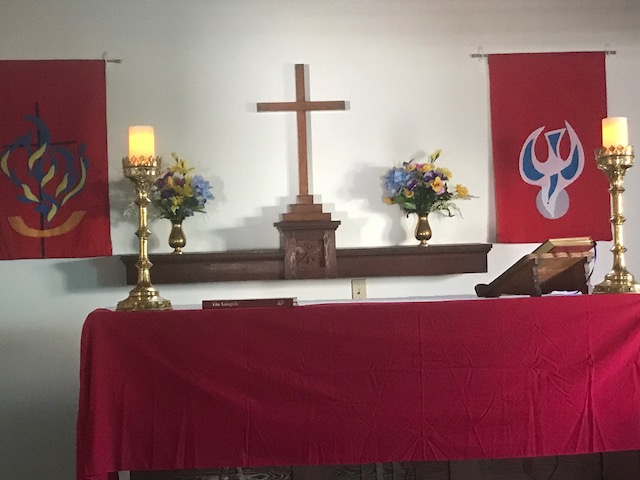
Sunday, August 26, 2018

Sermon: The Difficult Concepts


            Is there such a thing as objective beauty?  You know me and my fascination with comparative religion, so let's look at what the Tao te Ching says about beauty:  "Under heaven all can see beauty as beauty only because there is ugliness.  All can know good as good only because there is evil."  The Tao looks at comparative opposites as being necessary for either to exist.  It teaches a balance of things.
            Now, at the same time, St. Augustine teaches that God created all things good – just look at the first chapter of Genesis.  Therefore, as with darkness only being able to exist where there is light, evil does not exist by itself, but is an absence of good. 
            So to extrapolate from the first question – is there such a thing as objective beauty?  Can beauty exist without a comparison? 
            So let's tackle a question that is easier for us to answer, but still doesn't have an easier explanation:  can good exist without a comparison?  As Christians, we go back to the source – God pronounced His creation good, from the Earth to the Heavens to the animals to humans.  So of course good can exist without evil.  But why do we believe that?  More than that, why do we believe that, and others – like the Taoists – don't?
            The simple and complex answer, of course, is faith.  We have faith that the Bible is the Word of God, and that through the action of the Word, we meet Jesus Christ.  Our Gospel readings these last several weeks have had some pretty tough concepts to understand, and today, it culminates in many of Christ's disciples throwing up their hands, and saying, "This teaching is difficult; who can accept it?" 
            People like things to be clear and understandable.  It makes them clear-cut and able to be categorized.  Unfortunately, knowledge is rarely clear-cut and organized. 
            Did you know that there have been over 8.7 million species of creatures categorized by our scientists?  And that they categorize approximately 15,000 more every year?  Given what they know about our land masses, couldn't they extrapolate an approximate number of species in existence?  And yet, none of them are willing to do so.  Why?  Well, approximately 99% of all living space on Earth is under the ocean, but we've only explored about 10% of that.  Those statistics tell us that there's a lot more that we don't know than there is of what we do know.  And sometimes knowing how much we don't know causes us to have that much more faith that what we do know is accurate and true.
            But how many things do we truly not understand, and still accept it enough on faith that we move forward, just as the twelve disciples did in John's Gospel?
            Let's take for example, Paul's letter to the Ephesians.  Last week, the portion of the letter we read gave us specific examples of how to live:  to choose things wisely, and avoid drunkenness and debauchery; to be filled with the Spirit and exemplifying that through song.  This week, Paul refers to putting on the whole armor of God, using the metaphors of the belt of truth, the breastplate of righteousness, the shield of Faith, helmet of Salvation, the sword of the Spirit which is also the Word.  And ensuring that you're dressed head to toe, he advises that you wear whatever shoes will help you be ready to proclaim the Gospel of Peace. 
            There's plenty in that one passage to dig into and discuss, working to understand the complexities of each metaphor.  But right now, we're looking at things that are difficult to understand, and yet we accept that we do not understand them at present.  To do that, we're going to look just a few verses earlier in this letter, to a section that is tough for our modern-day minds to understand:  Paul addresses slaves and masters, exhorting slaves to obey their masters as they would obey Christ, and urging masters to treat their slaves well, as we all have the same Master in Heaven and He shows no partiality.  If God shows no partiality, why is slavery even an issue within Christian society?  And yet, Paul does not tell masters to free their slaves.  He doesn't rail against a social norm of the time.  How do we justify our belief and understanding in the protection of the Armor of God, without addressing the spectre of slavery just 5 verses before?  If you're interested, I just listened to a podcast this week that had an interview with Scot McKnight, who wrote a commentary about Paul's Letter to Philemon, which deals almost entirely about the subject of slavery. 
            The disciples this week don't actually understand the concepts of Christ being the bread of life, of eating his flesh and drinking his blood.  Christians had a reputation for being cannibals in the early formation of the Church for a reason.  They repeated the words of Christ, sharing the bread and wine of the last supper, but not truly understanding them.  Simon Peter's response to Christ's question of whether they would be leaving Him as well is pretty straightforward:  “Lord, to whom can we go? You have the words of eternal life. We have come to believe and know that you are the Holy One of God.” 
            Religious scholars are numerous as they work through the meanings of words, the context in which they're set, the genre of passages, etc.  Some scholars spend their entire lives trying to figure out one concept, writing article after book after commentary, and finding that truly, it comes down to faith.  The unknown is answered by our faith in God.
            We, like the twelve disciples in today's Gospel, are willing to stay and struggle with the difficult concepts.  Through our baptism, our confirmation, and both our request for our daily bread in the Lord's Prayer and our participation in the Eucharist, we choose to act on what we know and believe, and trust that understanding of the rest will come in time.  We reiterate Joshua's statement, "as for our house, we will serve the Lord."  May the peace of God, which surpasses all understanding, guard our hearts and our minds in Christ Jesus.

Sunday, August 19, 2018

Sermon - Wisdom

Today, in Proverbs, we are introduced to Lady Wisdom.  There's a ton of symbolism to work through in those first few verses of Chapter 9, but I want to start with Verse 10:  "The fear of the Lord is the beginning of wisdom, and the knowledge of the Holy One is insight."

Fear in the Old Testament doesn't carry the same connotation that it does today.  Fear comes from the Hebrew word yirah, which has a whole range of meaning within the Hebrew scriptures.  It can mean the fear we feel in anticipation of danger or injury, but it can also mean awe or reverence.  The "fear of the Lord" includes an overwhelming sensation of the glory, worth and beauty of God. 

Some Jewish sages link yirah with another word that comes from the same root, ra'ah, which means seeing.  They feel that if we really see life as it is, we will be filled with wonder and awe over the glory of it all.  Think about that for a second.

Abraham Herschel, who write God in Search of Man, wrote "Awe is an intuition for the dignity of all things, a realization that things not only are what they are but also stand … for something supreme.  Awe is a sense for transcendence, for the mystery beyond all things.  It enables us to perceive in the world intimations of the divine, to sense the ultimate in the common and the simple:  to feel in the rush of the passing the stillness of the eternal.  What we cannot comprehend by analysis, we become aware of in awe."  He notes that such awe is not the goal of wisdom – like some state of nirvana – but rather its means.  We start with awe and that leads us to wisdom. 

So let's start there.  Lady Wisdom invites the simple, those without sense, to come and eat the meal she has prepared.  She's asking that they lay aside their simple, empty lives, to "live, and walk in the way of insight."  She's asking that we step beyond the awe we feel, for that is not the goal, and step into wisdom.

Now interestingly, those words, while different, have the same meaning as the words Christ speaks in our Gospel lesson today.  He invites us to a meal:  "I am the living bread that came down from heaven. Whoever eats of this bread will live forever; and the bread that I will give for the life of the world is my flesh."

And in taking that step from simply being in awe of Him and what He chooses to do for all humanity, we start our way into Wisdom, "Those who eat my flesh and drink my blood have eternal life, and I will raise them up on the last day; for my flesh is true food and my blood is true drink. Those who eat my flesh and drink my blood abide in me, and I in them" – to live and walk in the way of insight. 

Pretty words.  But how do we go from simple to insightful?  We've talked in the last month or so about asking God for our daily bread.  In doing that, we allow ourselves to abide in Christ, and for Christ to abide in us.  We've taken the first step.  So what are other steps to gain wisdom?

Well, wisdom comes from making mistakes – but not just making them – learning from them, and not making the same mistakes again.  There are plenty of mistakes out there for us to make.  If we keep making the same mistakes, then we're not learning, and we're not gaining wisdom. 

How do we find the right mistakes to make?  By trying new things, gaining experiences that we haven't had before.  While one definition of insanity is doing the same thing over and over again, and expecting a different result, the definition of wisdom is the ability or result of an ability to think and act utilizing knowledge, experience, understanding, common sense, and insight. 

Someone once said that a wise man learns from the mistakes of others, because no one lives long enough to make them all himself.  So, gaining experiences that are new to us, is one of the first steps to putting the path of wisdom found in the Bread of Life to use.  Learning from both the mistakes of others, and more importantly, the wisdom of others is the next step. 

Talk to someone you've never spoken with, old or young, with the intention of learning something from them.  Everyone has something to teach.  One of the best lessons I ever learned was from a 5 year old, who wanted to know why I took the word of someone else without even asking her what had happened from her perspective.  I learned to never assume you have the whole story when you've only listened to one person.

You can take a class, teach a class with the intention of collecting the most useful and interesting questions, find a mentor, read a book.  Step out of your comfort zone.  Challenge yourself.  And know that even if you fail, you have gained knowledge, and know how to apply that knowledge to gain wisdom. 

Finally, listen to Paul's words to the Ephesians:  "Be careful then how you live, not as unwise people but as wise, making the most of the time, because the days are evil. So do not be foolish, but understand what the will of the Lord is."

Think about the people you know, particularly the simple and those "without sense."  Invite them to a meal, where they can receive the Bread of Life, and start their own path to Wisdom and insight.  If they lack the Living Bread, they won't find the path to Wisdom.  And we vowed in our baptismal covenant to proclaim by word and example the Good News of God in Christ – with God's help.  Our Daily Bread lives within us.  The Holy Spirit is here to guide us to way of Wisdom. 

This faith of ours isn't just a belief.  It has to be an action.

Let us pray:  O God, who by thy Holy Spirit does give to some the word of wisdom, to others the word of knowledge, and to others the word of faith: We praise thy Name for the gifts of grace and we pray that thy Church may never be destitute of such gifts; through Jesus Christ our Lord, who with you and the Holy Spirit lives and reigns, one God, for ever and ever. Amen.

Saturday, August 4, 2018

Sermon - We Are What We Eat

We are what we eat.  We've all heard that phrase, but where did it come from?  Interestingly, despite all of the current hype about food quality and natural versus organic versus processed, etc., the phrase comes from 1826.  A chef by the name of Jean Anthelme Brillat-Savarin said, "Tell me what you eat and I will tell you what you are."  He was literally saying that a person’s mental, emotional, and physical health could be determined by what they ate, and indeed, their very character revealed. The idea that good food led to good character and good health and that bad food corrupted, both morally and physically, has hung on ever since, in some way or another.

But I think we can see in today's Gospel that Jesus said it first.  “Very truly, I tell you, you are looking for me, not because you saw signs, but because you ate your fill of the loaves. Do not work for the food that perishes, but for the food that endures for eternal life, which the Son of Man will give you. For it is on him that God the Father has set his seal.”

The allegory of the type of bread that we choose to eat is speaking not to a person's physical health, but rather to their spiritual health.  Our problem is not that we eat bread, but that when faced with a choice, we often choose poorly.

For instance, from our Old Testament lesson, the Israelites were provided with "bread from heaven", but they didn't know exactly what it was, so they called it manna.  Manna literally means "what is it?"  It wasn't bread ready to eat – it was a concentrated form of something that could be made into bread or cakes.  As a result, they never changed the name, and always called it manna – what is it?  The Israelites were surely not the only ones to have eaten of the bread of complaint, dissatisfaction and fear.

In our modern day, in the Middle East, both sides eat of the bread of violence and war.

Politicians of every ilk share the bread of negativity, hostility and name calling.

Sometimes, we eat of the bread of hurt feelings and resentment; other times of loneliness, fear and isolation; and still others of sorrow, guilt and shame.

We are what we choose to eat.

Shall we eat of the bread of power and control, or perhaps the bread of revenge?

The bread we choose to eat reveals a great deal about the nature of our appetite.  The world is full of bread, and yet far too many live their lives unfulfilled and searching.

In a little bit, we're going to sing the song, "I AM the bread of life."  But think about the words of Christ:  “I am the bread of life. Whoever comes to me will never be hungry, and whoever believes in me will never be thirsty."  And then think of the refrain of that song:  "And I will raise him up."

Every interaction that we have, every thought in our head, every action that we take – is a reflection of the bread that we choose to eat.  Each of the types of bread that I listed before are temporal and perishable.  And in every situation, each and every day of our lives, just as each day saw new manna, as the old was now inedible, we have the choice of the bread we will eat – perishable or imperishable.  And in each of those choices, we choose the life we want to live.  We are what we eat.

Someone asked me what the Episcopal Branch of the Jesus Movement means.  The Presiding Bishop Curry explains it pretty well.  In choosing to live a life oriented around the teaching of the Gospel, we demonstrate to others that our faith is loving, liberating and life giving.  We commit ourselves to going into the world to help the world become what it will become.  And the power of the Holy Spirit moving through me allows other people to see what Christ's way is all about, and allows me to choose the Bread of Life with every interaction.

So I'd like to challenge you this week to begin each day asking God to give you the Bread of Life – we ask for it every time we say the Lord's Prayer, so think about what exactly that means, every time you say it.  And when you ask for the Bread of Life, you ask Him to allow you to be the witness to Jesus' word and ministry today.

At the end of each day, reflect – without judgment – and ask yourself, where did I have an opportunity to practice witnessing?  And that doesn't have to be words, but can be actions or gestures, simple examples of the loving, liberating and life-giving ways of Christ.  Ask yourselves, did I take advantage of those opportunities I had?  Where might I have chosen differently than I did?  And thank God for His provision of the Bread of Life, for His gift of Jesus Christ to us – in all that that means.

Let us pray:  God, our hope, as we gather now to worship you, fill us with anticipation and prepare us by your Spirit. Be the first thought in our hearts and help us to be conscious of your direction. Strengthen us for your service, nourish us with the bread of life, transform us for your work.  In the name of Jesus Christ, we ask this. Amen.

Wednesday, July 25, 2018

Feast of St. James


Today, we celebrate the Feast of St. James, the first among the apostles to be martyred, son of Zebedee.  To find out more about James, you can read or listen here.

The collect of the day is: 
O gracious God, we remember before thee this day thy servant and apostle James, first among the Twelve to suffer martyrdom for the Name of Jesus Christ; and we pray that thou wilt pour out upon the leaders of thy Church that spirit of self-denying service by which alone they may have true authority among thy people; through the same Jesus Christ our Lord, who liveth and reigneth with thee and the Holy Spirit, one God, now and for ever. Amen. 

Monday, July 23, 2018

Sermon - God's Shepard

Sometimes, you have to wonder why God answers prayers the way He does.  Even when He gives us what we want – what we've asked for, begged for at times – more of His response has to do with what we need instead.  In today's reading from Jeremiah, we see the results of Him talking with the prophet, essentially planning an end run around the repetitive desire of the Hebrew people for a king.  He'd already provided them with prophets.  Saul, as we saw in the last couple of weeks, ended up being a complete failure as a monarch.  The people didn't need a king other than His own reign, but they could learn a lesson or two along the way, and he would establish the line of David for His plans for their future.

In the meantime, we see His irritation at the scattering of His flock.  Likewise, in our second lesson, we see the separations of people into categories has continued.  That too, seems to be a human trait that we continue through the present time.

Samuel Colgate, the founder of the Colgate business empire, was a devout Christian, and he told of an incident that took place in the church he attended. During an evangelistic service, an invitation was given at the close of the sermon for all those who wished to turn their lives over to Christ and be forgiven. One of the first persons to walk down the aisle and kneel at the altar was a well-known prostitute. She knelt in very real repentance, she wept, she asked God to forgive her, and meanwhile the rest of the congregation looked on approvingly at what she was doing. Then she stood and testified that she believed God had forgiven her for her past life, and she now wanted to become a member of the church. For a few moments, the silence was deafening.

Finally, Samuel Colgate arose and said, "I guess we blundered when we prayed that the Lord would save sinners. We forgot to specify what kind of sinners. We'd better ask him to forgive us for this oversight. The Holy Spirit has touched this woman and made her truly repentant, but the Lord apparently doesn't understand that she's not the type we want him to rescue. We'd better spell it out for him just which sinners we had in mind." Immediately, a motion was made and unanimously approved that the woman be accepted into membership in the congregation.

How many times a day do we categorize people?  How many times do we put ourselves into boxes?  Some labels can outlast your lifetime.  Let's try this:  you finish the name:

  • Attila the ---- Hun. 
  • Conan the ---- Barbarian. 
  • Billy the ---- Kid.
  • Catherine the ---- Great. 
  • Rahab the ---- Prostitute.

As we become known as our titles, our roles, our circumstances of life, our labels, we tend to act in those ways.  What people expect is what they're going to see, and getting out of those boxes is a long, uphill battle.

But we've also seen how Christ has renamed people – repurposed their lives for His use.  Simon the fisherman became Peter, the fisher of men, the Rock upon which the Church was built; Saul was a destroyer of Christians, but upon becoming Paul, became a builder of the Church.  So let's look at our second lesson.

How many different categories does Paul mention in his letter to the Ephesians?  The circumcised and uncircumsized, aliens, strangers – but he points out what Christ is for us.  In His flesh He has made us one.  He has broken down the dividing wall and the hostility between us.  He creates one new humanity, that they might reconcile to God in one body through the Cross.  And in so doing, we become citizens with the saints, members of the household of God – joining together to become the holy temple of God.

So now we have different labels, far more positive, that call us to be our best selves.  And we're brought to the Gospel.  And brought full circle back to God's plans for humanity.

The liturgy today cuts out portions of this chapter of Mark, but we still know the stories.  We know that Jesus is of the line of King David, established by God so long ago in our history.  And we know that Christ is here to get across to the people that the kingdom is of God, and that God's kingdom is established here on earth through Christ.  But the interesting part of today's Gospel is that in being physically here, God can see what is needed, right now.  He sees a disparate group, separated by their labels, their roles, their preconceptions – wandering around like lost sheep, and knows that what they need, right now, is compassion, and a Shepard, giving them a direction to go.  He provides us the way of uniting as one humanity, working together to form that Kingdom of God.

The challenge to us, the expectation that we accepted when we were baptized, is to live up to what the Shepard expects.  Take a look at Page 305 in your Book of Common Prayer.  "Will you proclaim by word and example the Good News of God in Christ?"  Our response, "I will, with God's help."  The Shepard, the King sent to us by God is still our help.  The Holy Spirit is right there, ready, willing and able to help us fulfill this baptismal vow.

"Will you seek and serve Christ in all persons, loving your neighbor as yourself?"  Will you set aside labels, categories, skin colors, where somebody came from?  Will you recognize that they, too, are part of the Kingdom of God, that the Shepard has led them to us for a reason?  Our response, "I will, with God's help."

And finally, "Will you strive for justice and peace among all people, and respect the dignity of every human being?"  Our response, "I will, with God's help."

We have a lot going on in this country, where divisions are more and more rampant.  I objected to the concept of a hyphenated American – African-American, Mexican-American, Irish-American – but what I was missing was that all of those hyphens ended with American, that the commonality was built into that hyphen.  Our Shepard reminds us that even American is a label – "Will you strive for justice and peace among all people, and respect the dignity of every human being?"  That's our challenge set before us in God's plan.  We know that the only answer to that is that we will strive for that, through Christ.  We will try to see through His eyes, so that all we can see are members of the community of God, the Kingdom of Heaven, and realize that each one is a needed and necessary part of that community.

Let us pray:  O God, you made us in your own image and redeemed us through Jesus your Son: Look with compassion on the whole human family; take away the arrogance and hatred which infect our hearts; break down the walls that separate us; unite us in bonds of love; and work through our struggle and confusion to accomplish your purposes on earth; that, in your good time, all nations and races may serve you in harmony around your heavenly throne; through Jesus Christ our Lord. Amen.

Saturday, July 14, 2018

Sermon - Family Drama

Family drama.  We all have it.  Television has an entire genre of soap operas, dedicated to family drama of fictitious characters, and while we think such things could never happen in real life, today's readings are full of family drama.

Michal, David's wife, had once been madly in love with her husband.  We read that David was pleased to know that, but never once does the Bible indicate that he also loved her.  He did, however, kill 200 Philistines and provided their foreskins as the bride price to Saul, Michal's father.  Now, David was looking for a way to find political legitimacy by getting in good with the royal family.  Saul was looking for a way to get rid of this upstart, and so set the bride price, knowing the problem of David would be eliminated once he went up against the Philistines.  He promised David that he could marry his eldest daughter for the bride price, and in the meantime, knowing David was going to die, he married his eldest daughter off to another man.  David returned, and Saul was kind of stuck to keep his promise.  Unfortunately, Saul also realized that David was favored of God, and he didn't want to lose his throne.  After the marriage of David and Michal, he sent men to kill David, and Michal, not wanting to become a widow so soon after marriage, hid David so he could escape.

The drama takes a new twist as Saul, angry with his daughter for letting David get away, declares her deserted, and marries her off to someone else.  David, meanwhile, goes about gathering the kingdom together, gaining supporters, not to mention a couple more wives, and the Lord allows Saul and his sons to die, ironically when they're going to lose to the Philistines, giving the kingdom over to David.  At this point, 18 years later, when we assume that she's learned to live happily with her second husband, David decides he wants his first wife back – he paid for her in foreskins, mind you – and over the objections of her present husband, takes her back with him.  Now Michal's stuck, one among many – which was not what she signed up for – and looking out the window, likely feeling like a prisoner, sees even more evidence that she does not come first with David.  From her perspective, he's out there, dancing like a fool in homage to God, humiliating himself – and her, she believes – by dressing in little clothing, and tossing every ounce of royal decorum on its ear.  He is willing to demean himself in front of his people.  She doesn't recognize that he is willing to humble himself before God in true joy at God's presence.  She only knows that she despises him now.

So let's see what drama the royal family from today's Gospel lesson got to.  First, it gets a little confusing because we actually know some things about this family from the historian, Josephus, including names, which can get a bit confusing in the Bible.  The Herod family really liked the name.  So, Herod I, begat Herod II, also sometimes called Herod Philip – and he married Herodias, named for her grandfather – and if I'm reading the ancestry chart correctly, Herod II was her uncle.  They had a daughter Salome.  Josephus tells us that Herodias divorced her husband by "confounding the laws" (women couldn't divorce men at that point), and then she married Herod Antipas, Herod II's half-brother.  Enter John the Baptist, who immediately condemned the marriage, telling Herod Antipas that he could not legitimately marry his brother's wife, particularly since his brother was still alive.  Like all good couples that don't want to be told what to do, they weren't happy about this.  Herodias was all in favor of killing John the Baptist immediately.  However, her husband, for some reason unknown even to himself (hello – God at work here), liked John the Baptist, and so simply imprisoned him, occasionally having visits and listening to John's words, which he found fascinating.  It was like having his own private prophet he just kept in the dungeon.  Herodias was furious, but unable to persuade her husband, she bided her time and watched for an opportunity.  That opportunity came fairly quickly when her daughter danced for her step-father and the court at a state dinner one night.  She apparently did so well, her step-daddy offered her anything she wanted, up to and including half his kingdom.  Now if this were a soap opera, I've no doubt where the storyline would go, but, this is the Bible, so we get to see a different sort of human atrocity.  Salome didn't know what to ask for, so she asked her mother what she should request.  Herodias took the chance she'd been offered, and told her daughter to ask for the head of John the Baptist.  Salome took the concept, embellished a little bit, and asked her stepfather for the head of John the Baptist, on a platter.  One has to wonder how many of the dinner guests managed to keep their food down at that presentation.

Even looking at the Episcopal Church – one has to admit that we have more than our fair share of "family" drama.  As an interesting aside, a former Archbishop of Canterbury, Rowan Williams, made the statement, that a priest who follows the plotlines of a soap opera or a novel is someone who "has a fair bit of literacy about the world we're in - literacy about our culture, about the human heart."

Family drama.  We, ourselves, experience our own family dramas – feuds, secrets, skeletons, abuse, addictions, divorce, custody battles – you name it, and families somewhere experience it. 

But since it's such an obvious problem, why is it mentioned in the Bible SO often? 

Well, let's go to our New Testament lesson, and listen to the words of Paul:  God has "blessed us in Christ with every spiritual blessing in the heavenly places."  "He destined us for adoption as his children through Jesus Christ."  He blessed us with forgiveness, and gave us a "plan for the fullness of time, to gather up all things in him, things in heaven and things on earth."  We have a heavenly family, wholly perfect and pure, through the birth, death and resurrection of Jesus Christ.  No family drama, no soap opera, just a choice to believe, and be adopted into the family of God. 

So next time you're experiencing your own family soap opera, remember that this life is very temporary, and our Father in Heaven is waiting on us to join our family there.  Forgive those driving you crazy today, and look forward to the blessings you'll reap as an adopted son or daughter of God.

Let us pray:  O God, you made us in your own image and redeemed us through Jesus your Son: Look with compassion on the whole human family; take away the arrogance and hatred which infect our hearts; break down the walls that separate us; unite us in bonds of love; and work through our struggle and confusion to accomplish your purposes on earth; that, in your good time, all nations and races may serve you in harmony around your heavenly throne; through Jesus Christ our Lord. Amen.

Sunday, July 8, 2018

Thorns

"Therefore, to keep me from being too elated, a thorn was given me in the flesh, a messenger of Satan to torment me, to keep me from being too elated." (2 Cor. 12:7)  I chuckled quietly in the back of the church this morning hearing this verse.  We all have our "thorns" to deal with as we move forward, to keep us from our heads getting too big or from letting our egos get away from us.  And to remind us that it's not we who accomplish these things, but we with God's help who accomplish things.

So, in that sense, this past week saw the very slow beginnings of Noonday Prayer each day - a very short (@ 10 min) service to remind us that the thorns God grants us are gentle reminders that we're here for His service.  The middle of the day is a good time for such a reminder - it can get us through the afternoon without wanting to strangle someone. 

This next week, we'll switch things up a little and use the New Zealand Midday Prayer - same length of time, but the wording is slightly different.  The New Zealand Prayer Book is truly a masterpiece of poetry and prose, even just to read through.

We've got a couple of events coming up that I'll put here, just to have you mark them on your calendar - more will be announced later:

Saturday, July 29, 6:45 p.m. - Compline Service followed by a showing of I Can Only Imagine.
Saturday, August 11, 1-5 p.m. - Crockpot Cooking Workshop

Next Sunday will be another Deacon's Distribution (Mass), at 9:00 a.m.   Everyone's welcome, and we hope to see you there!